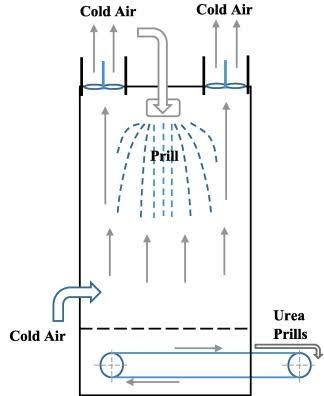
A Industrial Prilling Tower is a vertical granulation system designed to convert molten materials into uniform spherical prills through controlled droplet formation and solidification. Molten feed is distributed at the top of the tower through a prilling head, forming droplets that fall under gravity. As the droplets descend, counter-current or co-current airflow cools and solidifies them into free-flowing spherical granules. The system ensures consistent prill size, high throughput, and efficient heat removal, making it suitable for large-scale continuous production.
Used For
Solidification of molten chemicals into spherical prills
Production of uniform granules from melt feed
High-capacity continuous granulation processes
Applications requiring free-flowing spherical product
Integration with upstream melting and downstream cooling systems
Industrial Prilling Tower
Explore Our Pilot Plant Trial Facility At katalyzer technologies, we offer a state-of-the-art pilot plant trial facility right on our premises. Clients can leverage this resource to test our products and services before making a commitment. After the trial period, you'll have the freedom to decide whether to proceed with placing an order, ensuring confidence in your decision-making process.
For accurate design and sizing of a Prilling Tower, the following information is required:
Material Properties
-
Material name and description
-
Melting point (°C)
-
Viscosity of molten material
-
Density (molten and solid)
Production & Capacity Data
-
Required production capacity (TPH or kg/hr)
-
Target prill size range (mm)
-
Acceptable size distribution tolerance
Thermal & Cooling Parameters
-
Molten feed temperature (°C)
-
Inlet cooling air temperature (°C)
-
Required outlet product temperature (°C)
-
Ambient temperature and humidity
Airflow & Tower Parameters
-
Required airflow rate (m³/hr)
-
Tower height and diameter (to be finalized)
-
Air velocity inside tower
-
Pressure drop
Utilities & Integration Data
-
Power supply for blowers and controls
-
Integration with melting system
-
Downstream cooling, screening, and conveying requirements
-
Emission control and dust collection system
Purpose of This Data
This information is used to determine tower height, airflow rate, cooling capacity, prilling head design, and overall system configuration to ensure uniform prill formation, stable operation, and efficient heat removal.
-

